2026-08-30
Modelica vs. Simulink: Which Tech Stack Leads System-Level Modeling in the AI Era?
A side-by-side test of AI-assisted model generation on Modelica and Simulink, and what it says about which platform is ready for an AI-driven modeling future.
In today's rapidly evolving landscape of engineering, automation, and AI, system-level modeling has become the backbone for designing, simulating, and optimizing complex multi-domain systems. Two leading tech stacks dominate this domain: Modelica and Simulink.
But as AI-assisted model generation rises to the forefront, a new and urgent question emerges: which platform is better positioned to thrive in an AI-driven modeling future — Modelica or Simulink?
This article compares Modelica and Simulink not just as tools of the past, but as platforms for the future, through the lens of automation, openness, and intelligent model generation.
What is system-level modeling?
System-level modeling enables engineers to represent mechanical, electrical, thermal, fluid, and control systems in a unified simulation framework. It helps:
- Predict system behavior early in the design process
- Validate designs before building physical prototypes
- Optimize performance and integration across domains
As AI increasingly automates engineering tasks, the ability of a modeling tool to interact with AI pipelines, support text-based generation, and handle hybrid modeling (physics + data) becomes a competitive advantage.

Real-world AI comparison: Simulink vs. Modelica
To test practical AI-assisted model generation, we asked Claude 3.7 the same question for both platforms: create a simple physical behavioral model for a bouncing ball.
Simulink test
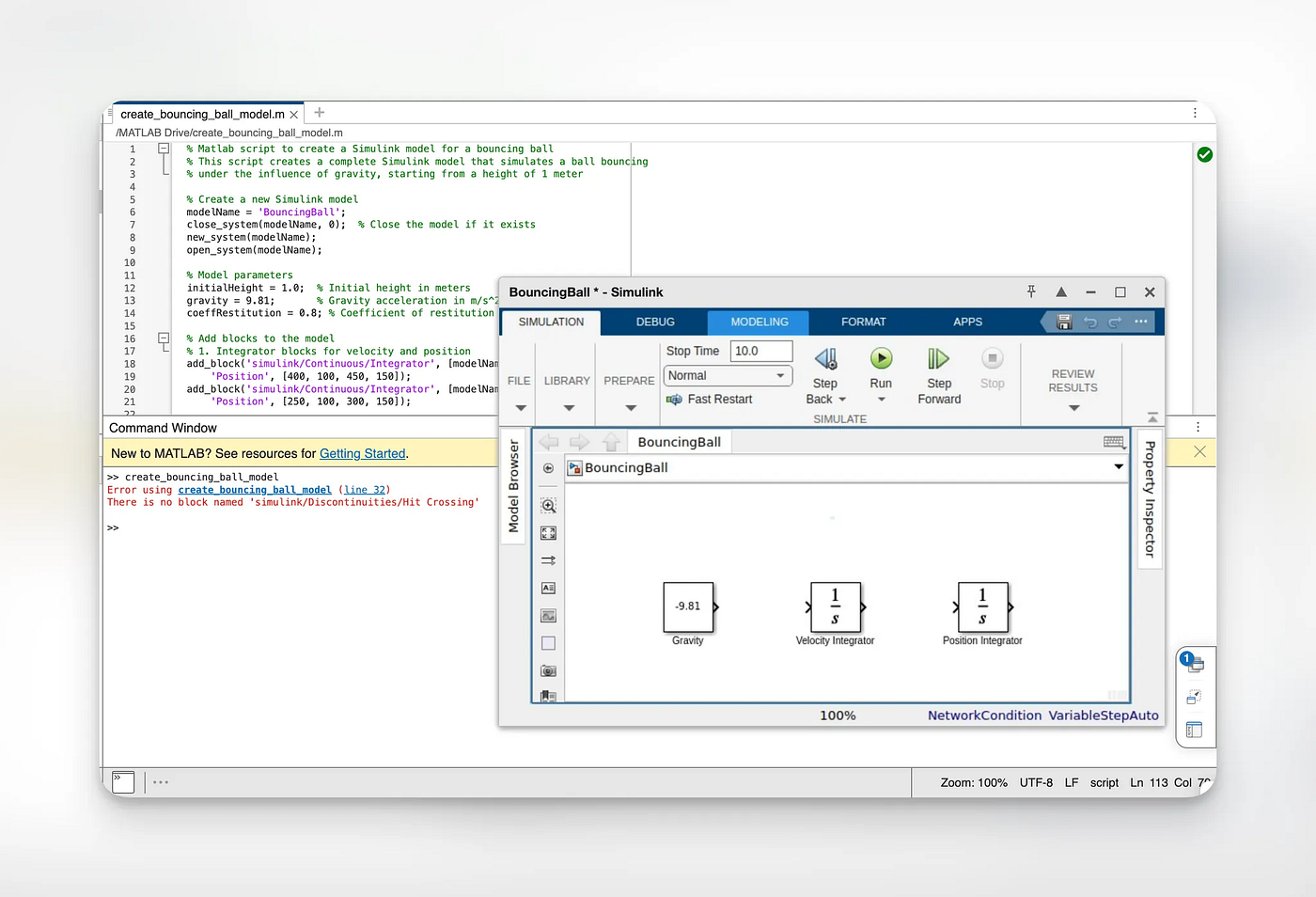
- Prompt: create a Simulink model using a MATLAB script for a bouncing ball.
- AI output: view Claude's response.
- Result:
- The script failed to generate a complete, runnable Simulink model.
- Tried on matlab.mathworks.com — the simulation did not run.
- Diagram blocks were incomplete or missing connections.
Modelica test
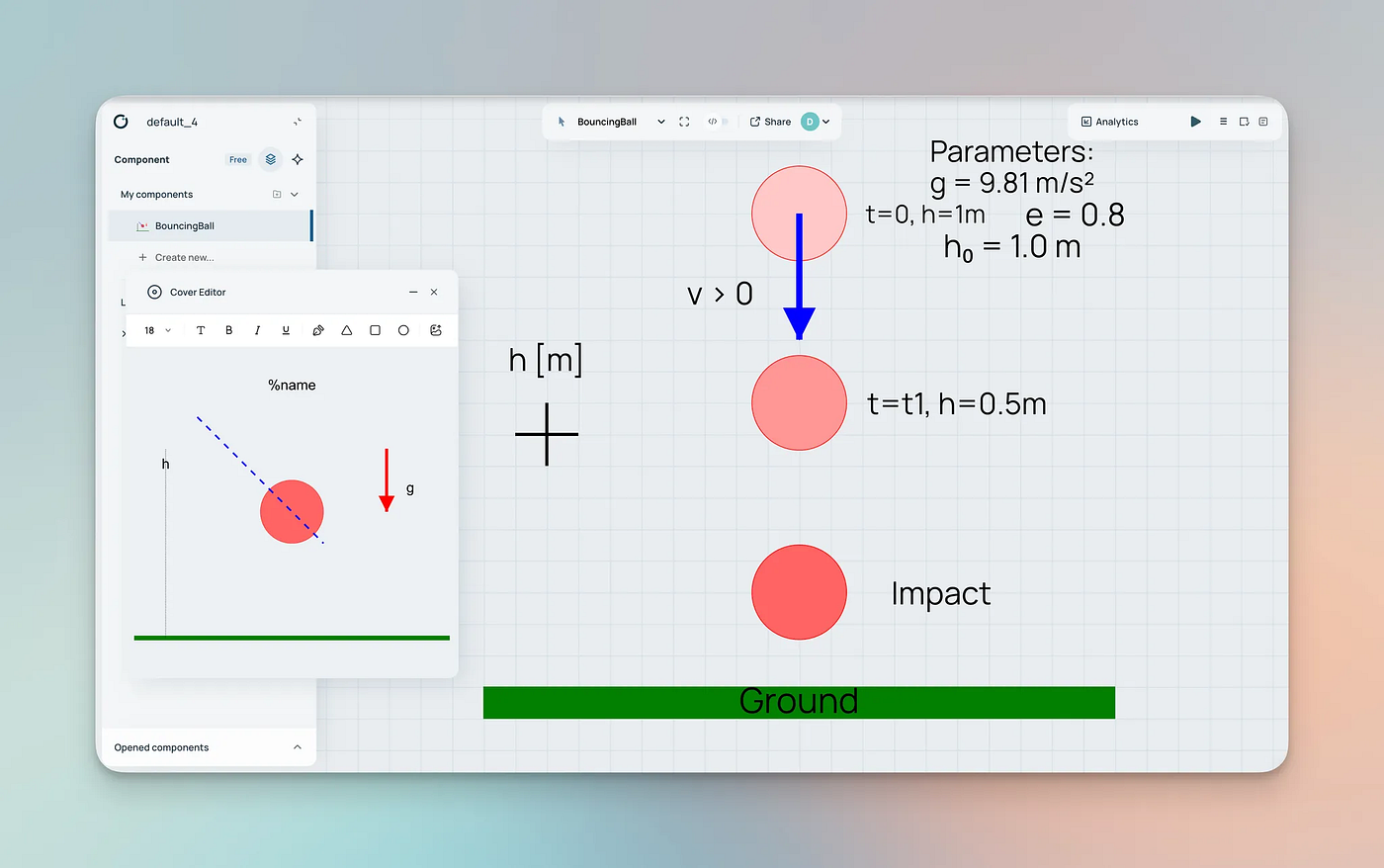
- Prompt: create a Modelica model for a bouncing ball with a graphical diagram.
- AI output: view Claude's response.
- Result:
- Copied into ODE+ Component, a web-based Modelica IDE.
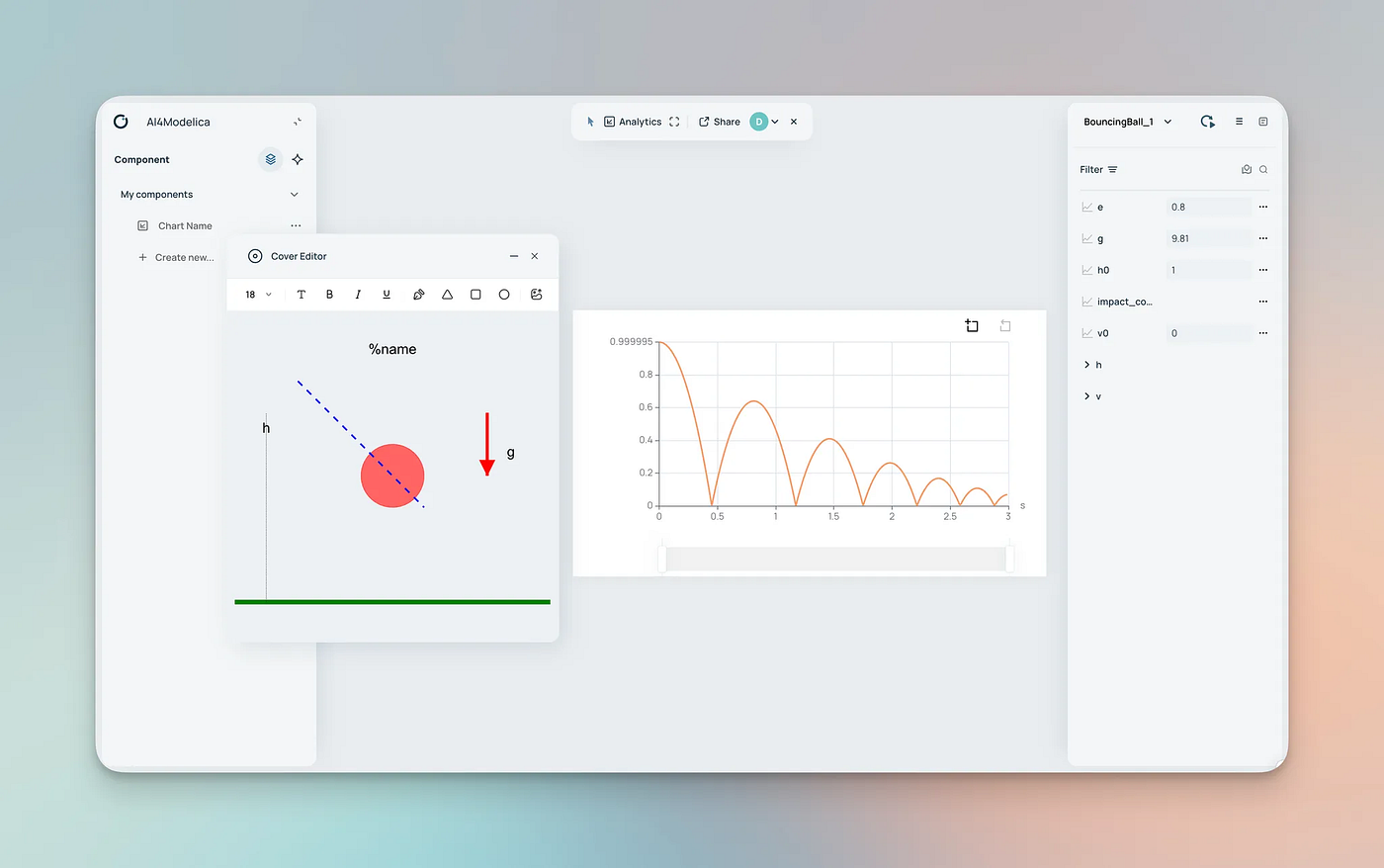
- The model ran successfully on the first try.
- Generated both icon and diagram views.
- Try this example yourself: live simulation on Orthogonal.
Modelica: open, modular, and AI-ready
Modelica is a declarative, object-oriented language for physical modeling across domains. It is:
- Open-standard. Supported by an international community and tools like OpenModelica, Dymola, and ODE.
- Equation-based. Lets users describe what the system does, not how it does it, which is ideal for physical systems.
- Composable and hierarchical. Components can be reused and structured like code.
- Highly compatible with AI. Easy integration with Python ML stacks, notebooks, and automation pipelines, including code-generated models from AI prompts and hybrid modeling (physics + ML).
It plays well with modern LLMs and Python-based AI tools.
Simulink: visual modeling with MATLAB power
Simulink, developed by MathWorks, is a widely used block-diagram environment for dynamic system modeling. It is:
- Visually intuitive. Ideal for control systems and rapid prototyping.
- MATLAB-integrated. Taps into MathWorks' extensive toolboxes for simulation, analysis, and embedded code generation.
- Industry-proven. Common in aerospace, automotive, and robotics applications, with AI/ML models built in MATLAB and reinforcement-learning toolboxes.
But AI-assisted model creation is more constrained due to its closed ecosystem and limited scripting flexibility outside MATLAB.
AI era takeaway: which platform wins?
If your focus is AI-assisted modeling, Modelica clearly leads: it is compatible with LLM-generated code, runs directly in open-source or web IDEs, and supports hybrid AI-physics modeling.
But if your team is already deeply embedded in the MATLAB/Simulink ecosystem, especially in aerospace, automotive, or embedded applications, Simulink still holds strong practical value.
Final verdict
Modelica is the future-ready platform for intelligent, AI-assisted system modeling. Simulink remains a proven workhorse for traditional, industry-grade workflows.
In the coming years, as engineering teams embrace code generation, ML-driven optimization, and self-building models, Modelica's openness and adaptability make it a natural fit.